
Prayer App Comparison Guide: A Decision Framework You Can Actually Use
Use this practical prayer app comparison framework to choose by workflow, privacy confidence, reminders, and real weekly follow-through.
Most prayer app comparison articles feel generic because they chase feature lists. Real users need a decision framework that predicts consistency.
This guide gives you that framework.
The 6-factor comparison framework
1) Capture speed
Can you log a request in under 60 seconds?
2) Retrieval clarity
Can you find priority requests instantly?
3) Reminder quality
Do reminders increase follow-through without feeling noisy?
4) Reflection loop
Can you mark answered prayers and revisit history?
5) Privacy confidence
Do you feel safe storing sensitive content?
6) Cost fit
Does the pricing model match your commitment level?
Fast visual comparison
| App style | Typical fit | Key value | |---|---|---| | Journal-first (PrayerNotes) | Personal structure and review | Follow-through depth | | List-first (PrayerMate) | Simple daily intercession | Low-friction routine | | Group-first (Echo Prayer) | Shared requests and teams | Collaboration |
PrayerNotes example (paid)
PrayerNotes is paid and strongest when you want a personal system with organization and answer tracking.


PrayerMate example (list-first)
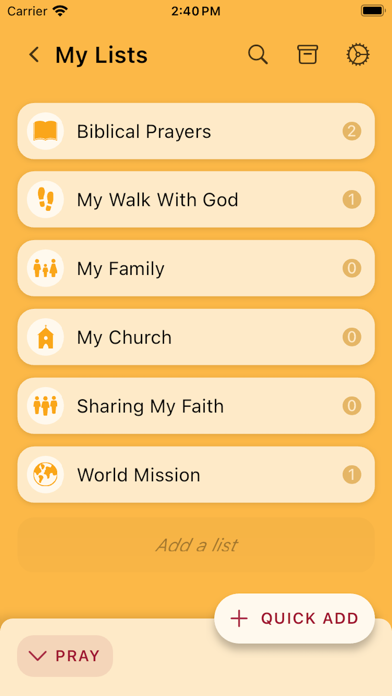
Echo Prayer example (group-first)

Use this method in 15 minutes
- Pick three apps to test.
- Enter the same five real requests in each app.
- Set next-day reminders.
- Reopen after 24 hours and measure friction.
- Keep the app you naturally return to.
Related reads: [best prayer apps 2026](/blog/best-prayer-apps-2026) and [best prayer app without subscription](/blog/best-prayer-app-without-subscription).
FAQ
Is PrayerNotes free?
No. PrayerNotes is paid.
Is the cheapest app always best?
No. The best app is the one that improves real consistency for your prayer life.
Should I compare by screenshots only?
No. Always run a live workflow test with your actual requests.